
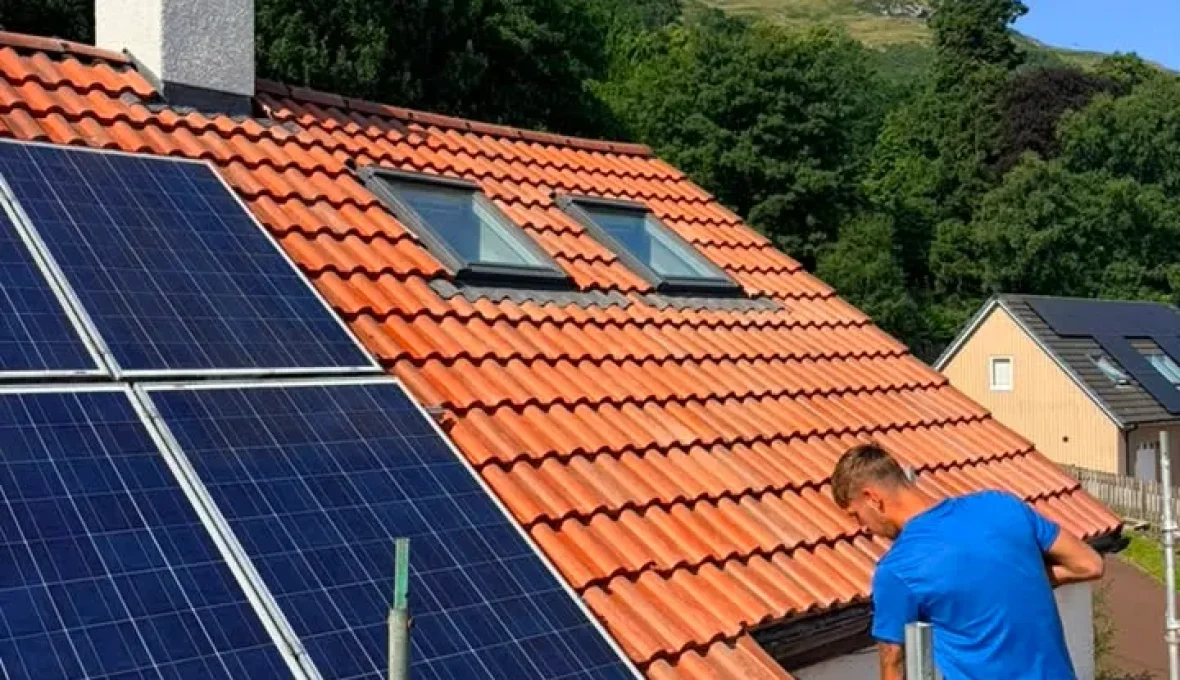
Most full pitched re-roofs in Stirling, Alloa and Falkirk land around £9,500 to £22,000 including scaffolding and VAT, depending on slate or tile and how much sarking needs replaced.
The big money swings are scaffolding, waste uplift, leadwork (Code 4 or Code 5), and surprise timber repairs once the old roof is off.
If it is local damage, a proper repair is usually £250 to £1,800, but if you have nail sickness or repeated leaks, a re-roof is the cheaper option long-term.
Roofing costs in Central Scotland vary because the roofs vary. A 1950s semi in Bannockburn with concrete tiles and clear access is a different job from a 1900 sandstone villa in Bridge of Allan with slate on sarking boards, chimneys, valleys, and tight scaffolding. As a realistic 2026 guide, a full new pitched roof (strip and re-cover) is commonly £9,500 to £22,000 in the Stirling to Alloa corridor, and it can be higher on larger villas or where timber is tired. The only honest number is the one after a site survey, but this will get you close enough to budget properly.
Two houses can have the same footprint and still be £8,000 apart on a roof price. In Stirling, Alloa and Falkirk we see a lot of older slate roofs fixed to sarking boards, plus post war concrete tiled roofs on battens. The slate ones can hide trouble until you strip them, split sarking, soft rafter ends, and old underlay that has turned to dust. That is why anyone giving you a fixed price over the phone is guessing.
Weather matters as well. After Storm Babet, Storm Isha and Storm Éowyn, we were seeing more displaced ridges, failed flashings and water tracking in at chimneys. That does not automatically mean you need a full re-roof, but it does mean you might find defects that have been brewing for years. If you are pricing up a full job, think in terms of a proper scope of works, not just “new tiles”.
– William Young, Owner
The main cost drivers are straightforward. First is access and scaffolding. A simple gable on a driveway in Fallin might take a basic scaffold, but a tight street in Stirling town centre or an Alloa terrace with no rear access needs more lifts, more protection, and more time. Scaffolding alone is commonly £1,200 to £3,500 for a typical house, and £4,000 to £6,500 on bigger 2 storey and 3 storey villas.
Second is what you are covering it with, slate, clay tile, concrete tile, or a flat roof covering. Third is how much you are renewing underneath, sarking boards, battens, breathable membrane, ventilation, and fixings to current practice. For slating and tiling we work to BS 5534, and for slate quality and grading you will see BS EN 12326-1 referenced on decent specification slates. Those standards do not make the roof expensive, they stop it being false economy.
Leadwork is another one that gets missed in cheap quotes. Chimney flashings, step flashings, valleys and soakers should be done properly in lead, usually Code 4 on flashings and Code 5 where it needs more robustness, like wider gutters and exposed details. Budget £450 to £1,200 for straightforward chimney leadwork, and £900 to £2,500 if you are into valley renewals, multiple chimneys, or awkward abutments. If you are comparing quotes, make sure leadwork is written in, not hand waved.
Budget £1,200 to £3,500 for most houses, more for villas, tight streets, or shared access.
Uplift, disposal and skips are commonly £600 to £1,800 depending on volume and how cleanly we can load out.
Allow a contingency. Replacing sections of sarking and rafter end repairs can add £800 to £4,500 when defects are widespread.
Proper Code 4 and Code 5 leadwork plus a sound ridge system is often the difference between a roof that lasts and a roof you chase every winter.
For a typical 3 bedroom house in Stirling, Alloa, Bannockburn or Sauchie, think of a pitched roof area around 70 to 110 square metres. On concrete tile, straightforward shape, one chimney, and decent access, a full strip and re-tile commonly lands £9,500 to £14,500 including scaffolding and VAT. If you are into a bigger footprint, multiple hips and valleys, or a second chimney, you are more like £13,500 to £19,500.
On slate, the range is wider because of the material and the traditional Scottish build up. Where we are re-slating and also renewing sarking boards and a breathable membrane, typical totals are £14,000 to £22,000 for a standard house, and £20,000 to £35,000 for larger sandstone villas in places like Bridge of Allan and Dunblane. A lot of that is labour, because you are working with slate gauge, headlap, correct fixings, and reinstating details around dormers, verges, and chimneys.
Here is a simple way to read our quotes, we separate the big cost blocks so you can see where your money is going. If you want the service pages for what we actually do day to day, start with re-roofing and roofing, it is the same work but different scopes depending on how far you need to go.
If you want a straight comparison, slate is usually the highest up front cost, but it can be the best long term value if it is specified and fixed properly. In Central Scotland we fit Welsh, Spanish, and reclaimed Scotch slate through our slate roofing service, and we see a lot of older properties where matching matters. On listed buildings or conservation areas in Stirling, you can be pushed towards reclaimed slate and traditional detailing, which adds time and procurement cost.
Tile is often the best budget option on modern housing stock. Concrete tiles are practical, available, and quicker to lay, so your labour cost is usually lower than slate. Clay tiles sit above concrete on price, but can be worth it for certain profiles and finishes. If you are already on tile, tiling is normally the most cost controlled route because we can specify a known profile and build to current underlay and batten requirements.
Felt on pitched roofs is not a “roof covering”, it is part of the build up, but a lot of folk mean flat roof felt. For garages, dormers, and small extensions in Falkirk and Grangemouth we still install high performance torch on systems where it suits the detail, through felt roofing. As a ballpark, felt is often cheaper up front than EPDM or GRP, but your decision should be based on the detail at edges and outlets, not the headline square metre rate. If you want a deeper comparison, we will be linking a guide soon, see Article 4 on slate vs tiling in the related posts.
A repair is cheaper when the roof still has life left in it. If you have a few broken slates, a slipped ridge, a local leak at a valley, or flashing that has lifted, a repair might be £250 to £1,800 depending on access and the detail. A lot of the cost is still scaffold. That is why we always look at whether a scaffold can cover more than one defect while it is up, for example sorting a chimney, checking the ridge, and renewing a short run of fascia at the same time.
Replacement becomes the cheaper option when you are repeatedly paying for call outs and patching. On older slate roofs around Stirling and Clackmannanshire we often see nail sickness, widespread delamination, and underlay failure. Once water is tracking on rotten sarking, you are into chasing leaks rather than fixing them. If you are getting two or three leaks each winter, or you have visible sagging at the eaves, you are usually better pricing a full scope under re-roofing rather than throwing another £600 at the next patch. For a cost breakdown of common fixes, see Article 10 on roof repair costs in the related posts.
– William Young, Owner
We cover Stirling (FK7) as well as Alloa, Falkirk and the wider Central Belt. A proper quote starts with a site visit. We check the ridge, hips, valleys, verges, chimney head and flashings, eaves, fascia and soffit lines, and we look for signs of past patching and water tracking. If it is a slate roof, we pay attention to slate gauge, the condition of the fixings, and whether it is on sarking boards or battens. We will also talk through whether you want like for like, or a specification upgrade such as breathable membrane and improved ventilation.
If your roof is a shared roof, common repairs can get political fast. Falkirk Council pushes the Novoville Shared Repairs route for some blocks, and Clackmannanshire has a Private Housing Assistance Scheme. None of that guarantees a free roof, but it can help with coordination, advice, and sometimes financial assistance depending on your situation. If you are renewing fascias, soffits and gutters at the same time, it is usually cheaper to bundle it while the scaffold is up, see fascias, soffits and guttering.
If you are budgeting for roofing costs in Central Scotland, start with the roof type and access. A typical tile re-roof is often £9,500 to £19,500, and slate is commonly £14,000 to £35,000 depending on the property and how much timber is getting renewed. The only way to tighten that range is a survey and a written scope that mentions membrane, battens or sarking, ridge and verge details, and leadwork specification.
If you want a free quote in Stirling, Alloa, Falkirk or anywhere in between, call us and we will come out, measure properly, and tell you what needs done now and what can wait. You will get a clear price, clear materials, and a workmanship guarantee in writing.
Call a roofer if you have water staining on ceilings, dripping in the loft, slates or tiles on the ground, or mortar falling from the ridge. If you are in a tenement or block and the leak is travelling, get it looked at quickly, because water will follow timbers and show up two rooms away from the entry point.
If the roof has had repeated patch repairs, or you can see sagging at the eaves line, get a survey and a proper scope. We can advise whether it is a targeted repair or a full strip and re-cover, and we will price it with scaffolding, waste, membrane, fixings, and leadwork written in, so you are not guessing. We cover Stirling, Alloa, Falkirk, Dunblane and the wider Central Scotland area. Call 01259 726404 or message us on WhatsApp.
For a typical house in the Central Belt, a full pitched roof replacement is often £9,500 to £22,000 including scaffolding and VAT, with larger slate villas commonly £20,000 to £35,000. The biggest variables are access, slate versus tile, and how much sarking and timber needs replaced once stripped.
A repair is cheaper when the issue is local, like a few slates, a short ridge run, or a flashing, often £250 to £1,800. If you have nail sickness, repeated leaks, or failing sarking across the roof, replacement usually works out cheaper over a few winters.
Installed properly, natural slate can last several decades, sometimes much longer, while concrete tiles are commonly a few decades depending on exposure and maintenance. Lifespan depends on slate grade, fixings, leadwork, ventilation, and whether the build up meets standards like BS 5534.
Sometimes, but it is not a blanket grant for everyone. Clackmannanshire and Falkirk run schemes of assistance that can provide advice, practical support, and in some cases financial help, usually prioritised and subject to eligibility and budgets.

William has spent over two decades on Scottish roofs, working from apprentice slater to running a Stirling-based team that re-roofs villas and repairs storm damage across the central belt. He writes about roofing the way he talks on a survey: straight, costed and honest.
40+ yrs combined experience · Stirling · NFRC member
Targeted fixes for slipped slates, broken tiles, valleys, and leak tracing across Stirling and the Central Belt.
Full strip and replacement with breathable membrane, new battens, correct fixings, and tidy leadwork details.
Eaves level repairs that stop overflow and rot, often the hidden cause of recurring damp at the roof edge.
